Well, 2016 is over. If you're to believe the mainstream media, it's been the worst year ever, and it's fairly easy to see why. With Britain voting to leave the EU and Donald Trump now President-elect of the United States, many liberal-leaning people will have found this a fairly disasterous 12 months. Even if you're a right wing Euroskeptic, there have been so many celebrity deaths that it has at times felt like a sick joke. That said, there have been many positives too. I'm not a huge sports fan, but even I think TeamGB having their most successful Olympics to date is pretty cool. Globally, carbon emissions have stalled and poverty has fallen. The tiger population has increased for the first time in a century. Hyperbole and drama may sell newspapers, but they're unlikely to reveal the full story.
For me personally, 2016 has been a pretty successful year. I (finally) passed my membership exams, started working at registrar level, graduated from my MSc and moved in with my boyfriend - can't complain at that! Of course, some things haven't gone quite so well. I didn't record my resolutions last year, but no doubt they'll have included weight loss, which hasn't happened to any significant level, and increased exercise, which has happened on occasion but hasn't really been sustained. Nonetheless, on the whole, it's not been a bad year for me.
So, will I be making resolutions this year? It's difficult not to, but it seems silly making the same ones I've made (without much success, obviously), year on year for over a decade. Whilst I'd love to be slimmer and fitter, they're relatively superficial goals. Instead, I'm going to set myself some other challenges:
- I am someone who looks after other people, both in my work as a doctor and at home when I like to feed and generally "mother" my friends and family, however I'm pretty bad at looking after myself. Therefore, I am going to try much harder with self care this year. There are lots of little things I can do, but mostly it's about remembering that I'm actually worthy of being looked after.
- I tend to be quite a negative thinker. I assume the worst in most situations, and almost always assume that I have done the wrong thing, annoyed people and am generally a terrible human. Linked in with my self care resolution, I'm going to try to think more positively, particularly about myself. There are plenty of things I'm probably good at, and believing in myself doesn't make me a dreadful person.
- I compulsively apologise for everything - sometimes I even say sorry when I'm not sure what I'm sorry for. It's silly and to be honest, probably quite annoying that I basically apologise for existing. So, I'm going to stop saying sorry unless it's actually warranted.
As I've stated on many occasions before, I've struggled with my mood for a long time, and I'm hoping that these resolutions will help with that. We live in a world where we are constantly shown how well everyone is doing. One of the lovely things about social media is that we are able the share our friends' good news and happy occasions quickly. Engagements, weddings, graduations, pregnancies, holidays and nights out are all photographed and shared within minutes. It's therefore easy to believe that everyone else is living a perfect life whilst we're barely holding it together. To borrow an excellent quote from a friend's daughter, the problem here is comparing our friends' "highlights" with our own "outtakes". So the next time I scroll through facebook and feel miserable that everyone else is partying, holidaying, succeeding and being perfect, I need to remember that my own profile looks just the same. Anyway, there's nothing wrong with watching Netflix in your onesie with a cup of tea - it just doesn't make a great photo!
Showing posts with label Self Esteem. Show all posts
Showing posts with label Self Esteem. Show all posts
Sunday, 1 January 2017

Thursday, 27 October 2016
You're So F*ckin' Special, I Wish I Was Special...
I once heard a friend of mine, frustrated with a mutual acquaintance, utter the words "he always has to be special!" Said acquaintance, this friend felt, was never satisfied with being "normal", he must be "special". I remember it well, because I realised when she said it how easily she could have been talking about me. I don't know this particular acquaintance well enough to know whether his reasons for needing to be "special" are the same as mine, but the comment on it made me think about myself and the way other people may perceive me.
Let me clarify. I don't like being "average". Getting a "satisfactory" rating on an assessment upsets me. It's not because I think I'm better than that - I don't. In fact, it's quite the reverse. I inexplicably consider myself to be absolutely rubbish. I feel like most people start out at neutral and I'm already minus 50. If I'm not special, above average, exceeding expectations in some areas, then I don't even out at "ok".
One of the odd things about low self esteem is that, to the casual observer, it can look remarkably like arrogance. A frustration with others not doing things I can do looks like a stuck up "why can't everyone be as good as me?!", when in reality it's more like "it can't be difficult if I can do it!", much like disappointment at an "average" rating might suggest I think of myself as better than that, rather than worse. Unfortunately, hearing yourself described as overconfident or arrogant only serves to reinforce the belief that everyone thinks you're rubbish, making you more likely to do/say the things which get you labelled as arrogant. I guess in medicine, we'd call it a positive feedback mechanism, although ironically it's fuelled by negative feedback.
Another odd thing about low self esteem is that, after a while, it becomes so ingrained that you don't even consciously think about it any more. On being asked "how did that go?", you instantly reply "dreadful", even though it may not have been that bad. You're no longer capable of seeing yourself in any way other than crap at everything. A boss of mine once told me to "stop with the self deprecation, it's boring". Naturally, this was a sign that, on top of all my other flaws, I bored people around me too. When said boss later said I was "demonstrably not crap", all I could think was "but you said I was boring". The lower your self esteem gets, the more you cling on to negative feedback as gospel and reject anything positive as either "trying to be nice" or "they don't know the *real* me" (see earlier blog on imposter syndrome).
This blog seems to go round in circles sometimes. I started off thinking I had something useful to say, and now I'm not sure I do. Perhaps just the writing is therapeutic. Either way, I'm sorry I insist on being special. I'd be delighted with normal, if only I felt it were genuinely true.
Let me clarify. I don't like being "average". Getting a "satisfactory" rating on an assessment upsets me. It's not because I think I'm better than that - I don't. In fact, it's quite the reverse. I inexplicably consider myself to be absolutely rubbish. I feel like most people start out at neutral and I'm already minus 50. If I'm not special, above average, exceeding expectations in some areas, then I don't even out at "ok".
One of the odd things about low self esteem is that, to the casual observer, it can look remarkably like arrogance. A frustration with others not doing things I can do looks like a stuck up "why can't everyone be as good as me?!", when in reality it's more like "it can't be difficult if I can do it!", much like disappointment at an "average" rating might suggest I think of myself as better than that, rather than worse. Unfortunately, hearing yourself described as overconfident or arrogant only serves to reinforce the belief that everyone thinks you're rubbish, making you more likely to do/say the things which get you labelled as arrogant. I guess in medicine, we'd call it a positive feedback mechanism, although ironically it's fuelled by negative feedback.
Another odd thing about low self esteem is that, after a while, it becomes so ingrained that you don't even consciously think about it any more. On being asked "how did that go?", you instantly reply "dreadful", even though it may not have been that bad. You're no longer capable of seeing yourself in any way other than crap at everything. A boss of mine once told me to "stop with the self deprecation, it's boring". Naturally, this was a sign that, on top of all my other flaws, I bored people around me too. When said boss later said I was "demonstrably not crap", all I could think was "but you said I was boring". The lower your self esteem gets, the more you cling on to negative feedback as gospel and reject anything positive as either "trying to be nice" or "they don't know the *real* me" (see earlier blog on imposter syndrome).
This blog seems to go round in circles sometimes. I started off thinking I had something useful to say, and now I'm not sure I do. Perhaps just the writing is therapeutic. Either way, I'm sorry I insist on being special. I'd be delighted with normal, if only I felt it were genuinely true.
Sunday, 1 November 2015
I'm Not A Lousy Doctor - But I'm A Lousy Friend
If you've read this blog before, you'll probably be aware that I'm a prolific tweeter. In fact, I'd be surprised if you were reading and had come across this post via anything other than seeing me tweet about it. One of the things I love about Twitter is that it makes the world a smaller place. One of my favourite Tweeters is the lovely @dr_ashwitt; although she is as far from me as is basically possible (Melbourne, if you were wondering), I frequently read her tweets and think "oh my God, me too!". Recently, Ash re-posted a link to a post she wrote a couple of years ago about her experiences of depression. She urged other doctors to post their own 140 character experiences of mental health issues, and #MH4Docs got a fair number of tweets which Ash has collated here. I haven't actually tweeted yet, but I've been pretty vocal about my own issues over the years and it's good to see that people feel they can open up about these things. The thing that really made me think, though, was the sentence she used to link to her blog.
"I have depression, but that doesn't mean I'm not a good doctor."
I think a big part of the reason that a lot of health care professionals (and non-health care professionals, come to think of it) are reluctant to open up about mental health issues is the fear that their abilities at work will be called into question. I know that one of my major fears when I "admitted" to having depression was that people might think I was unable to do the job I love and have worked for for a long time.
My mental health problems don't mean I'm not a good doctor. I have a need to be busy which means that I will crack on with as much work as I can, and I'll find non-essential tasks which just "need doing at some point" to keep me occupied. Focusing on other people means I'm not thinking about myself and my own emotions, so I'm unlikely to slip into a spiral of despair. My lack of self esteem and constant impostor syndrome mean I'm keen to please and make an extra effort to be friendly and polite. Work makes me feel better and I think my own issues mean I will always work as hard as I can. Possibly I'm at risk of burnout, but it's nothing I've ever felt close to, and the other hobbies I've developed to occupy myself and prevent negative thinking mean I have outlets outside of medicine.
No, depression doesn't mean I'm not a good doctor. It does mean I'm not a good friend, though. Being nice and polite to people can be frankly exhausting. After a whole day smiling and engaging in banal conversation and generally giving the impression that I'm a functional human being, I am absolutely worn out. I very rarely agree to after-work plans because I know I'll be too tired to be good company. If I've made arrangements, there's a good chance I'll flake out at the last minute because I just can't face being around people any more. Finally living alone rather than with flatmates is a Godsend because it means I can have meltdowns in the living room and kitchen rather than being restricted to my bedroom. On nights out, I'm renowned for disappearing without telling anyone after being consumed by an overwhelming wave of misery and wanting to get away before I spoil anyone else's night. As for relationships, I am probably one of the worst girlfriends out there. I take insecurity and anxiety to ridiculous levels, any compliment is analysed repeatedly to ensure it isn't actually a heavily veiled insult and "I love you" is not infrequently followed not with "I love you, too" but "..really? Do you actually though?".
So yeah, I have depression, and that doesn't mean I'm not a good doctor. But it does mean I'm not a good friend. If you've stuck around anyway, thank you. I may not say it with nights out or long conversations, I may cancel half of our arrangements and you might feel like you're walking on eggshells when we talk, but you are loved and appreciated.
Monday, 6 July 2015
Survival Tips For Medical Students
Tonight I noticed a tweet asking for top self-care tips for medical students, and (unsurprisingly) I felt I had too much to say to fit it into 140 characters, so I thought it might be worth a blogpost. Being a medical student is an amazing experience, but it can also be incredibly difficult for lots of reasons. This post isn't supposed to be in any way comprehensive. I'm not an expert, by any stretch. This is just a collection of suggestions and ideas based upon my own experiences and those of people I know.
Work hard.
Medicine is hard work. Most of it isn't intellectually particularly stretching, but there's a vast amount of stuff to learn and the majority of people will have to do a reasonable amount of work to keep on top of it. I'm not advocating becoming a hermit, but going to most of your lectures, showing up on the wards and keeping up with reading will mean exam season is far less stressful. If you have to actually learn everything from scratch, rather than just revise it, you'll be giving yourself a far more difficult task than is necessary.
Play hard.
It's also important to make the most of being a student. Go to toga parties. Play pub golf. Go clubbing whilst dressed as a giant chocolate bar or do garlic and chili body shots from the Med Soc president. Or don't, if you'd rather not. But don't feel like doing an academically demanding degree means you have to miss out on the student experience. A boss of mine once said "you can resit an exam, but you can't resit a party". I'm not sure that's the most sensible advice, but find a balance that makes you happy. Whether it's partying, music/sports/drama societies, volunteering or just reading novels and watching trashy TV, doing fun stuff is important. Keeping up with friends and enjoying yourself is an essential way of dealing with the stress you will feel from time to time. Speaking of friends, they're really important. Make sure you keep up with those outside of your course, too. Non-medics are brilliant for allowing you to properly relax and giving you a sense of perspective (medic friends are great and can relate to a lot of what you've experienced, but have an awful habit of talking shop so you don't truly escape medicine around them).
But don't forget to sleep.
Seriously, sleep is really important. When you're trying to balance partying and studying, sleep can seem like something you don't have time for, but it's essential. Everything seems worse when you haven't been sleeping well. As a medical student, you've embarked on a pretty awesome journey, but you need to be on top of your game to make the most of it.
Eat well.
OK, so it's boring, but it's another essential. If you're spending long days in lectures and then going out drinking, it can be tempting to sustain yourself on Pot Noodles and Red Bull, but there's no way you'll be at your best if you aren't getting a decent amount of vitamins, minerals, fibre etc. Sorry guys, your Mum is right about this one.
Exercise.
Similar to the above, exercise is useful for both keeping you physically at your peak and helping beat stress. As a naturally lazy person who would rather exercise by lifting a spoon from ice cream tub to mouth than go anywhere near a gym, I totally get that this is not top of some people's agendas, but it's amazing how much more energy you have after a swim or run. Even a brisk walk around the block is better than nothing.
Cry.
Sometimes you will see things that really resonate with you and upset you. This is absolutely OK. Allow yourself to be upset. Talk to a friend. Have a cry. I still get upset about cases from years ago (such as this one), Remember that if there ever comes a time when sad things don't bother you in the slightest, you probably want to think about a change of career.
Take a break.
OK, so this might go a little against what I said earlier about working hard, but it's important. Sometimes, things will get on top of you (see previous point). You might be unwell. You will have stressors in your life outside of medicine. If you're struggling, give yourself permission to take a sick day. There's no point dragging yourself in when you aren't going to be properly concentrating. Doctors are absolutely terrible for going into work when they're unwell. It does noone any favours. Learn now to spot when you aren't well and sort it out early. Even if you're cruising along fine, don't spend more time working than you have to. If your registrar says you can leave early, do. Don't spend the holidays in the library. Having time off is vital to your emotional and physical well being.
Don't let the b*st*rds grind you down.
There are horrible people everywhere. Some of them will be in your year, some will be your seniors, some will be non-medical colleagues. Giving you a dressing down if you're rude or you really don't know your stuff is fine, but nobody should be bullying you. If they are, report it. Snide remarks, sniggering behind your back, deliberately telling you lies about teaching sessions or criticising your appearance or personality is not acceptable. People who do this are, frankly, arseholes. They're probably covering up their own insecurities by pointing out yours. They may well be jealous of how awesome you are. Either way, it's not cool. Don't let it get to you. (But if you're actually being bullied, tell someone. There is help to stop this kind of thing from happening.)
Be the best you you can, not a second-rate someone else.
This is more general life advice I suppose, but in medical school where you're surrounded by brilliant people it's easy to constantly compare yourself to other people. Try not to. The people who may seem the best at uni are not necessarily the ones who make the best doctors. Focus on your weaknesses, by all means, and work on improving them, but don't assume that anyone who really understands the kidneys or can do a super-slick neuro exam is better than you at everything. Maybe you have a really lovely manner with confused old ladies or perhaps you know intricate details of the coagulation cascade. Whatever it is, you'll have something you're awesome at too. Remember what it is you do well, feel proud of it, and work on improving other stuff so that you become the best doctor you can be, not so that you can beat someone else in an exam.
That's a very brief run-down, but those would be my top "survival" tips. Most of all, remember to enjoy it. You're on your way to doing the best job in the world, and you're going to be awesome at it.
Work hard.
Medicine is hard work. Most of it isn't intellectually particularly stretching, but there's a vast amount of stuff to learn and the majority of people will have to do a reasonable amount of work to keep on top of it. I'm not advocating becoming a hermit, but going to most of your lectures, showing up on the wards and keeping up with reading will mean exam season is far less stressful. If you have to actually learn everything from scratch, rather than just revise it, you'll be giving yourself a far more difficult task than is necessary.
Play hard.
It's also important to make the most of being a student. Go to toga parties. Play pub golf. Go clubbing whilst dressed as a giant chocolate bar or do garlic and chili body shots from the Med Soc president. Or don't, if you'd rather not. But don't feel like doing an academically demanding degree means you have to miss out on the student experience. A boss of mine once said "you can resit an exam, but you can't resit a party". I'm not sure that's the most sensible advice, but find a balance that makes you happy. Whether it's partying, music/sports/drama societies, volunteering or just reading novels and watching trashy TV, doing fun stuff is important. Keeping up with friends and enjoying yourself is an essential way of dealing with the stress you will feel from time to time. Speaking of friends, they're really important. Make sure you keep up with those outside of your course, too. Non-medics are brilliant for allowing you to properly relax and giving you a sense of perspective (medic friends are great and can relate to a lot of what you've experienced, but have an awful habit of talking shop so you don't truly escape medicine around them).
But don't forget to sleep.
Seriously, sleep is really important. When you're trying to balance partying and studying, sleep can seem like something you don't have time for, but it's essential. Everything seems worse when you haven't been sleeping well. As a medical student, you've embarked on a pretty awesome journey, but you need to be on top of your game to make the most of it.
Eat well.
OK, so it's boring, but it's another essential. If you're spending long days in lectures and then going out drinking, it can be tempting to sustain yourself on Pot Noodles and Red Bull, but there's no way you'll be at your best if you aren't getting a decent amount of vitamins, minerals, fibre etc. Sorry guys, your Mum is right about this one.
Exercise.
Similar to the above, exercise is useful for both keeping you physically at your peak and helping beat stress. As a naturally lazy person who would rather exercise by lifting a spoon from ice cream tub to mouth than go anywhere near a gym, I totally get that this is not top of some people's agendas, but it's amazing how much more energy you have after a swim or run. Even a brisk walk around the block is better than nothing.
Cry.
Sometimes you will see things that really resonate with you and upset you. This is absolutely OK. Allow yourself to be upset. Talk to a friend. Have a cry. I still get upset about cases from years ago (such as this one), Remember that if there ever comes a time when sad things don't bother you in the slightest, you probably want to think about a change of career.
Take a break.
OK, so this might go a little against what I said earlier about working hard, but it's important. Sometimes, things will get on top of you (see previous point). You might be unwell. You will have stressors in your life outside of medicine. If you're struggling, give yourself permission to take a sick day. There's no point dragging yourself in when you aren't going to be properly concentrating. Doctors are absolutely terrible for going into work when they're unwell. It does noone any favours. Learn now to spot when you aren't well and sort it out early. Even if you're cruising along fine, don't spend more time working than you have to. If your registrar says you can leave early, do. Don't spend the holidays in the library. Having time off is vital to your emotional and physical well being.
Don't let the b*st*rds grind you down.
There are horrible people everywhere. Some of them will be in your year, some will be your seniors, some will be non-medical colleagues. Giving you a dressing down if you're rude or you really don't know your stuff is fine, but nobody should be bullying you. If they are, report it. Snide remarks, sniggering behind your back, deliberately telling you lies about teaching sessions or criticising your appearance or personality is not acceptable. People who do this are, frankly, arseholes. They're probably covering up their own insecurities by pointing out yours. They may well be jealous of how awesome you are. Either way, it's not cool. Don't let it get to you. (But if you're actually being bullied, tell someone. There is help to stop this kind of thing from happening.)
Be the best you you can, not a second-rate someone else.
This is more general life advice I suppose, but in medical school where you're surrounded by brilliant people it's easy to constantly compare yourself to other people. Try not to. The people who may seem the best at uni are not necessarily the ones who make the best doctors. Focus on your weaknesses, by all means, and work on improving them, but don't assume that anyone who really understands the kidneys or can do a super-slick neuro exam is better than you at everything. Maybe you have a really lovely manner with confused old ladies or perhaps you know intricate details of the coagulation cascade. Whatever it is, you'll have something you're awesome at too. Remember what it is you do well, feel proud of it, and work on improving other stuff so that you become the best doctor you can be, not so that you can beat someone else in an exam.
That's a very brief run-down, but those would be my top "survival" tips. Most of all, remember to enjoy it. You're on your way to doing the best job in the world, and you're going to be awesome at it.
Tuesday, 30 June 2015
The Drugs Don't Work, They Just Make You Worse
From time to time, I find myself "borrowing" song lyrics to title my posts. This is in part because I'm not hugely creative and partly because I'm usually listening to music of some sort whilst I'm writing, but mostly because if someone else has said it well before, then there's little chance of me saying it better.
Trying to describe how depression feels is almost impossible. Years and years ago, when I'd never met anyone else who had depression in "real life" and my support network was almost entirely a (sadly long-gone) forum, we used to tell each other "for those who understand, no explanation is necessary; for those who don't, none will suffice". It's cliched and horribly over-used, but there was an element of comfort in realising that you'd probably never fully make other people understand how you felt, so you were as well saving your energy and not bothering. One particular thread, however, which I recall over a decade later, was entitled "The Sounds of Depression". I don't recall exactly how it started, but we started to share song lyrics (as well as other literary sources) which summed up our feelings. We were unable to express exactly how we felt, but many of our musical heroes did a fine job of it. Years after I first heard them, I find some songs are still better able to describe my feelings than any words I could write. Tonight, I'm thinking of The Verve.
"All this talk of getting old
It's getting me down, my love
Like a cat in a bag, waiting to drown
This time I'm coming down"
Some days, this is exactly what it's like. You fumble through your existence, not ever being entirely sure what the point is. The inevitable drowning that you feel sure awaits means that attempting anything seems like a waste of effort. You won't be able to get out of the bag that encloses you, so maybe it'd just be easier to succumb. Settle down, drift off to sleep and let yourself gradually suffocate. The eventual result will be the same, only with less pain in the meantime.
It's no coincidence that, as well as summing up how I sometimes feel, these lyrics are from a song called "The Drugs Don't Work". Yesterday, I read a very well-written piece by the lovely @katiehodgie about cognitive behaviour therapy and how it doesn't always work, which got me thinking about my experiences of treatment.
I've mentioned this sort of thing in the past, but in different contexts. I described my first contact with mental health services in my post on adolescent mental health. If you happened to read (or hear) the grand round I gave on the same topic, you may recognise it. That's because it was copied and pasted directly from that blog. "Suzie" was, of course, me. I don't mind if people who heard the talk guessed, but I didn't want to just stand and talk about myself openly because it felt somewhat indulgent, and may have detracted from the fact that I wanted to emphasise the importance of understanding mental health for all of our current and future patients, not just myself.
You can see that my first experiences of the psychiatric team were less than ideal. Over the many years which have passed since that appointment, I have had numerous other attempts at treatment. The list of medications I've tried resembles the formulary of a major psychiatric unit. I went for CBT and tried seeing a psychologist. I've met several psychiatrists. Despite all of this, and despite being a qualified doctor, it sometimes takes me by surprise when I remember that depression is a chronic problem. I have to remind myself, and other people, that I might dip again. It's a bit of an apology and a bit of a warning, summed up by John Mayer.
"Suppose I said
I am on my best behaviour
And there are times
I lose my worried mind
Would you want me when I'm not myself?
Wait it out while I am someone else?"
I'm never sure when the best time is to explain that I may be "not myself" for a while. Does it put people off getting to know me? Possibly. Are some people none-the-less shocked by it and unable to cope with it? Absolutely. I think this experience of negativity is one of the reasons I find myself wanting depression to be a transient phenomenon. The idea that friends won't have to "wait it out" again is appealing. Sometimes, I even believe it will happen.
When I am in a "good" phase, I convince myself it was something that happened once before, but something I am now over; a dreadful nightmare from which I have thankfully awoken. When I'm at my lowest, I am like the aforementioned cat, trapped and suffocating in a bin liner wondering when the water will finally wash over and take it all away. But there is a middle ground. The days when I first suspect it might be back. The mornings I wake inexplicably early, feeling anxious about nothing in particular. The evenings I cannot focus on whatever book I try to read. The afternoons where I suddenly feel like going out with my friends later is an insurmountable task. These are the times when I start thinking there might be an answer. Maybe another pill. Perhaps a different kind of talking therapy. Eating better, exercising more, filling my time with positive things. Maybe, this time, it will stop. Sarah McLachlan explained it pretty well.
"Spend all your time waiting
For that second chance
For a break that would make it OK"
I wonder, during these days, what it will be that makes it OK. I live in a kind of limbo, hoping that eventually I'll find and answer. Someone, somewhere will snap their fingers and it will all be OK.
In my case, the drugs do work, at least a little. The appropriate dose does mean that my eating is under better control. I have fewer binges and feel less compelled to consume everything in sight. Although I have dips, it's a long time since I put myself in any real danger or tried to do myself any sort of major harm. So, they help a bit. The psychological therapies I've tried have given me a better understanding of myself and some of my quirks, but haven't really enabled me to deal with things in a different way or had much impact on how I live my life. I have no doubt that for some people, one or a combination of treatments will actually completely cure them. For most, though, I suspect things help a little, but never make it completely go away.
I sometimes feel like it would be easier if I never experienced the better days. There are times when I start to think happiness is a myth, that I will forever experience the world through a sort of grey fuzz. During these times, I start to accept the lowness. I forgive myself for having no energy and allow myself to wallow. I stop looking longingly at "normal" people and decide that's not how I'm supposed to be. I accept that a sort of ambivalence about whether I life or die isn't too bad.
And then there are the better days. I wake up as my alarm goes off, feeling like I've had enough rest. I genuinely enjoy the simple things - my morning cuppa, a sunny drive to work, chatting to an old friend. The fog seems to have lifted. I put the bad days behind me and get on with living. And then, out of nowhere, the black dog comes again. Happening at times when I can so vividly recall normality makes it all the worse; the sheer contrast with the way things have been is brutal. I'm stealing more lyrics now, this time from James.
"Now I've swung back down again
It's worse than it was before
If I hadn't seen such riches
I could live with being poor"
This is sometimes the worst thing of all. Those good days are reminders of what I'm missing. Without them, I could almost settle into the grey and accept things. It's those good days that make me wish for a magic wand, some kind of switch to make it all go away. Of course I don't wish I didn't have good days, but sometimes I think it would all be much easier not to be reminded that there's an alternative existence out there.
If you happen to meet me on a grey day, you may not notice. But if you do, if I seem distant or like I'm not listening, or if I make excuses not to meet you, please don't take it personally. Bear with me. I'll have another good day eventually. Matchbox 20 explain it better than I do.
"I'm not crazy, I'm just a little unwell
I know right now you can't tell
But stay awhile and maybe then you'll see
A different side of me"
Trying to describe how depression feels is almost impossible. Years and years ago, when I'd never met anyone else who had depression in "real life" and my support network was almost entirely a (sadly long-gone) forum, we used to tell each other "for those who understand, no explanation is necessary; for those who don't, none will suffice". It's cliched and horribly over-used, but there was an element of comfort in realising that you'd probably never fully make other people understand how you felt, so you were as well saving your energy and not bothering. One particular thread, however, which I recall over a decade later, was entitled "The Sounds of Depression". I don't recall exactly how it started, but we started to share song lyrics (as well as other literary sources) which summed up our feelings. We were unable to express exactly how we felt, but many of our musical heroes did a fine job of it. Years after I first heard them, I find some songs are still better able to describe my feelings than any words I could write. Tonight, I'm thinking of The Verve.
"All this talk of getting old
It's getting me down, my love
Like a cat in a bag, waiting to drown
This time I'm coming down"
Some days, this is exactly what it's like. You fumble through your existence, not ever being entirely sure what the point is. The inevitable drowning that you feel sure awaits means that attempting anything seems like a waste of effort. You won't be able to get out of the bag that encloses you, so maybe it'd just be easier to succumb. Settle down, drift off to sleep and let yourself gradually suffocate. The eventual result will be the same, only with less pain in the meantime.
It's no coincidence that, as well as summing up how I sometimes feel, these lyrics are from a song called "The Drugs Don't Work". Yesterday, I read a very well-written piece by the lovely @katiehodgie about cognitive behaviour therapy and how it doesn't always work, which got me thinking about my experiences of treatment.
I've mentioned this sort of thing in the past, but in different contexts. I described my first contact with mental health services in my post on adolescent mental health. If you happened to read (or hear) the grand round I gave on the same topic, you may recognise it. That's because it was copied and pasted directly from that blog. "Suzie" was, of course, me. I don't mind if people who heard the talk guessed, but I didn't want to just stand and talk about myself openly because it felt somewhat indulgent, and may have detracted from the fact that I wanted to emphasise the importance of understanding mental health for all of our current and future patients, not just myself.
You can see that my first experiences of the psychiatric team were less than ideal. Over the many years which have passed since that appointment, I have had numerous other attempts at treatment. The list of medications I've tried resembles the formulary of a major psychiatric unit. I went for CBT and tried seeing a psychologist. I've met several psychiatrists. Despite all of this, and despite being a qualified doctor, it sometimes takes me by surprise when I remember that depression is a chronic problem. I have to remind myself, and other people, that I might dip again. It's a bit of an apology and a bit of a warning, summed up by John Mayer.
"Suppose I said
I am on my best behaviour
And there are times
I lose my worried mind
Would you want me when I'm not myself?
Wait it out while I am someone else?"
I'm never sure when the best time is to explain that I may be "not myself" for a while. Does it put people off getting to know me? Possibly. Are some people none-the-less shocked by it and unable to cope with it? Absolutely. I think this experience of negativity is one of the reasons I find myself wanting depression to be a transient phenomenon. The idea that friends won't have to "wait it out" again is appealing. Sometimes, I even believe it will happen.
When I am in a "good" phase, I convince myself it was something that happened once before, but something I am now over; a dreadful nightmare from which I have thankfully awoken. When I'm at my lowest, I am like the aforementioned cat, trapped and suffocating in a bin liner wondering when the water will finally wash over and take it all away. But there is a middle ground. The days when I first suspect it might be back. The mornings I wake inexplicably early, feeling anxious about nothing in particular. The evenings I cannot focus on whatever book I try to read. The afternoons where I suddenly feel like going out with my friends later is an insurmountable task. These are the times when I start thinking there might be an answer. Maybe another pill. Perhaps a different kind of talking therapy. Eating better, exercising more, filling my time with positive things. Maybe, this time, it will stop. Sarah McLachlan explained it pretty well.
"Spend all your time waiting
For that second chance
For a break that would make it OK"
I wonder, during these days, what it will be that makes it OK. I live in a kind of limbo, hoping that eventually I'll find and answer. Someone, somewhere will snap their fingers and it will all be OK.
In my case, the drugs do work, at least a little. The appropriate dose does mean that my eating is under better control. I have fewer binges and feel less compelled to consume everything in sight. Although I have dips, it's a long time since I put myself in any real danger or tried to do myself any sort of major harm. So, they help a bit. The psychological therapies I've tried have given me a better understanding of myself and some of my quirks, but haven't really enabled me to deal with things in a different way or had much impact on how I live my life. I have no doubt that for some people, one or a combination of treatments will actually completely cure them. For most, though, I suspect things help a little, but never make it completely go away.
I sometimes feel like it would be easier if I never experienced the better days. There are times when I start to think happiness is a myth, that I will forever experience the world through a sort of grey fuzz. During these times, I start to accept the lowness. I forgive myself for having no energy and allow myself to wallow. I stop looking longingly at "normal" people and decide that's not how I'm supposed to be. I accept that a sort of ambivalence about whether I life or die isn't too bad.
And then there are the better days. I wake up as my alarm goes off, feeling like I've had enough rest. I genuinely enjoy the simple things - my morning cuppa, a sunny drive to work, chatting to an old friend. The fog seems to have lifted. I put the bad days behind me and get on with living. And then, out of nowhere, the black dog comes again. Happening at times when I can so vividly recall normality makes it all the worse; the sheer contrast with the way things have been is brutal. I'm stealing more lyrics now, this time from James.
"Now I've swung back down again
It's worse than it was before
If I hadn't seen such riches
I could live with being poor"
This is sometimes the worst thing of all. Those good days are reminders of what I'm missing. Without them, I could almost settle into the grey and accept things. It's those good days that make me wish for a magic wand, some kind of switch to make it all go away. Of course I don't wish I didn't have good days, but sometimes I think it would all be much easier not to be reminded that there's an alternative existence out there.
If you happen to meet me on a grey day, you may not notice. But if you do, if I seem distant or like I'm not listening, or if I make excuses not to meet you, please don't take it personally. Bear with me. I'll have another good day eventually. Matchbox 20 explain it better than I do.
"I'm not crazy, I'm just a little unwell
I know right now you can't tell
But stay awhile and maybe then you'll see
A different side of me"
Saturday, 10 January 2015
Mad, Sad, Bad....
I recently gave a departmental grand round (i.e. a talk open to all members of the paediatric department where I work) on adolescent mental health. Various people have been keen to hear/see what I had to say, so I've posted a slightly edited version below.
It wasn't intended to be a comprehensive discussion of mental health issues by any stretch, but I wanted to at least mention some of the more common issues we encounter as paediatricians. Obviously every topic I spoke about is worthy of a talk in its own right, but hopefully this will have made people think a little bit and generated some useful discussion.
***Trigger warning*** Discussion of self harm, suicide and eating disorders.
"When I was first asked to give this talk, I had two reservations. The first - would anyone want to hear a grand round from such a junior member of the team? That was dealt with pretty swiftly, with assurances that training level didn’t matter so long as content was good. Hopefully that’s something I can achieve. The second, however, was more of an issue. Would people actually want to listen to a talk on adolescent mental health? The answer to that was less positive. In fact, it was a resounding “no”. And I think that's part of the problem, and it's exactly why I decided I should give this talk.
Imagine you're in your usual clinical environment, be that A&E, clinic, the assessment unit, general practice... You're examining a patient, and you find this...


What does this matter? What's the impact of self harm? Well, there is evidence to suggest that in young people like Suzie, who self-harm, risk of premature death is considerably higher than in the general population. Whilst, unsurprisingly, risk of completed suicide is up to 25 times higher than those who don’t self-harm, risk of accidental death is seven times and death from natural causes twice as high as the general population. Mean years of life lost was over 25 for both males and females (Bergen et al., Lancet 2012). Self-harm is also associated with poorer educational and employment outcomes, increased risk of mental health problems and increased risk of substance misuse in later life (Mars et al., BMJ 2014). The UK has one of the highest rates of self-harm in Europe (at


So, what can we do about this? Well, they key is to listen. A recent report published by the Royal College of Psychiatrists, and endorsed by our royal college, the RCPCH, suggests that simply listening and taking a sensitive history has therapeutic benefit. Groups such as Cello and Young Minds, who do a lot of work with young people affected by these issues, find again and again that doctors do not feel comfortable dealing with mental health issues in young people. They do not feel they have the necessary skills to help and they don't know what they're supposed to do. However, the evidence shows that actually, something as simple as just talking about the issue in a sensitive way helps. We all have the skills to take an history and listen to someone. It isn't difficult or complicated, yet it helps to reinforce a positive image of healthcare services in a young person's mind and means they are more likely to engage with services in the future.
That's been a brief overview of adolescent mental health issues. Hopefully it's made you think about how you might deal with these issues, and reinforced that all of us have skills which will help us to deal with them.
I don't usually put references at the end of blogs, but in case anyone is interested, these are some of the papers I read whilst I was preparing this talk.
It wasn't intended to be a comprehensive discussion of mental health issues by any stretch, but I wanted to at least mention some of the more common issues we encounter as paediatricians. Obviously every topic I spoke about is worthy of a talk in its own right, but hopefully this will have made people think a little bit and generated some useful discussion.
***Trigger warning*** Discussion of self harm, suicide and eating disorders.
"When I was first asked to give this talk, I had two reservations. The first - would anyone want to hear a grand round from such a junior member of the team? That was dealt with pretty swiftly, with assurances that training level didn’t matter so long as content was good. Hopefully that’s something I can achieve. The second, however, was more of an issue. Would people actually want to listen to a talk on adolescent mental health? The answer to that was less positive. In fact, it was a resounding “no”. And I think that's part of the problem, and it's exactly why I decided I should give this talk.
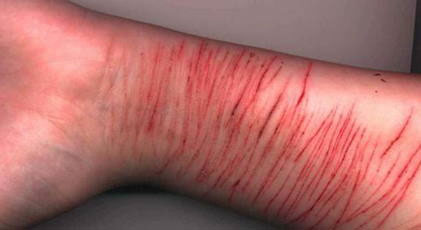
How do you feel about your patient now? Don't focus on what you think the differential is, think about your reactions and feelings towards this patient. Are they wasting your time? Are you less inclined to take their other complaints seriously? Are they an attention seeker? This may sound dramatic, but we're all guilty at times of responding negatively towards issues such as deliberate self harm.
There are lots of different ways in which I could represent the distress caused by mental illness, but I think one of the most effective is to share the story of a young person I've been involved with, including some of her quotes.
Suzie is 15. She presents to her GP after being encouraged
to attend by her form tutor. The consultation is difficult. After some
encouragement, she says that has been experiencing low mood for the past 3
years. She does not feel she has any friends. She feels that she is
unattractive and is not achieving at school. Her eye contact is poor and she
has a blunted affect. On examination, she appears well. Some superficial
lacerations are noted over her thighs and forearms.
This encounter is one Suzie still feels uncomfortable about.
“I was pretty cross that I’d been made to see a doctor. It’s hard enough for
people to get appointments without me taking them up. I actually felt quite
guilty about using a slot which could have been given to someone who was
actually ill. I was also really worried about admitting I cut myself. It seemed
like people felt that that was something done for attention, so I wanted to
hide it as much as I could; I didn’t want to be seen as an attention-seeker
when actually I just did it to try to feel better.”
Suzie is referred to CAMHS, who commence an SSRI and offer
CBT, which she declines.
Suzie vividly recalls her CAMHS appointment. “I was 15 and
it was the Christmas holidays. The department was located in an old, probably
Victorian, terraced house which hadn't been particularly well renovated. The
room I was seen in was freezing. There were two people seeing me; a middle aged
lady who was a social worker and a younger man who introduced himself as a
"trainee doctor" - I suspect that he was a psychiatry registrar but
at the time I was pretty convinced he was a medical student. They sat behind a
desk for the whole consultation and the seats for us (my parents were with me)
were a good few metres away from them. There was also a little window at the
top of the wall where someone else was apparently watching what was going on.
On the wall were several posters about how to deal with your child's difficult
behaviour and advising against smacking. There were toys all over the floor.
My first impression was that they thought I was a child
(which of course I was, at least legally, but what 15 year old doesn't think
they're incredibly grown up?). I don't recall much of the discussion we had. I
remember them repeatedly asking whether I'd ever been abused, and then later
taking great delight in asking my parents to leave the room so that they could
ask me again. Actually I only wanted my parents out of the room because I knew
they'd be upset if they knew the extent of my depression, but the doctor and
social worker seemed pretty desperate to uncover some horrific trauma which
must have caused my problems.
I didn't go back after that first appointment. They put me
on fluoxetine. They also wanted me to have CBT but I declined. In retrospect, I
probably should have gone for it, but at the time the only time I could cope
with being "mental" was to tell myself and everyone else around me
that it was due to "a chemical imbalance in my brain". Taking
medication to correct this was fine. To have CBT would have been admitting that
my thinking was fundamentally flawed and that it was therefore some weakness of
character resulting in my problems and not a "proper" illness. Of
course I know now that that isn't true, but the explanation I got was such that
that was what I believed at the time.”
Shortly after commencing treatment, Suzie attempts suicide
by taking 64 paracetamol tablets.
Even now, Suzie finds it difficult to articulate exactly why
she tried to end her life. “I was fed up of everything. Nothing I did seemed to
have any point. I didn’t think I’d ever achieve anything. I saw how unhappy my
Mum was, knowing I felt like this, and that made me feel incredibly guilty. I
was sure I was making my whole family miserable and that without me there,
they’d all be better off. I could just about believe that they might be
initially upset if I died, but I really felt that they’d get over that and be
far happier than they could with me around. I wanted to stop feeling miserable
and I wanted to stop dragging other people down with me.”
Suzie recovers from her suicide attempt with no residual
physical effects. She continues to self-harm by cutting herself with razor
blades. In addition, she begins to struggle with food, going through periods of
severe restriction followed by binges. She often induces vomiting and abuses
laxatives.
Although diagnosed with bulimia, Suzie feels that her eating
behaviour was closely linked with her mood. “Food made me feel better when not
a lot else did, but after I'd stuffed myself senseless I'd feel so guilty and
dirty that I'd have to make myself vomit... Some days, I just didn’t feel like
I’d possibly emptied my stomach, so I started taking laxatives too. I knew it
was dangerous but I didn’t care. I felt that I’d rather die than put weight on.
Sometimes, after a purge, I didn’t feel the need to cut myself as much. It was
like the vomiting was a kind of release, in the way that cutting was.”
Although all cases are very different, this is a fairly typical case. But so what?
What does this matter? What's the impact of self harm? Well, there is evidence to suggest that in young people like Suzie, who self-harm, risk of premature death is considerably higher than in the general population. Whilst, unsurprisingly, risk of completed suicide is up to 25 times higher than those who don’t self-harm, risk of accidental death is seven times and death from natural causes twice as high as the general population. Mean years of life lost was over 25 for both males and females (Bergen et al., Lancet 2012). Self-harm is also associated with poorer educational and employment outcomes, increased risk of mental health problems and increased risk of substance misuse in later life (Mars et al., BMJ 2014). The UK has one of the highest rates of self-harm in Europe (at
400 episodes per 100 000 population) (Hawton et al, Lancet
2012)
So what can we do about it? How can it be treated? Although self-harm within itself is not a diagnosis, the majority of young people who self harm will have an affective disorder, most commonly depression, although anxiety, eating disorders and psychotic disorders such as schizophrenia may also occur. The only licensed anti-depressant for under 18s is
fluoxetine. Paroxetine (Seroxat) in particular has been linked with increased risk of
self-harm and suicide after initiation of therapy, but there is some risk with
all anti-depressants. There are multiple theories as to why this is, but it may
be to do with returning energy levels and drive once treatment is commenced.
It's therefore important to ensure that any young person commenced on anti-depressant therapy have regular follow-up and support. The evidence base for any therapy is limited, although psychological therapies
are being increasingly developed and investigated.The current recommendation is that moderate-severe depression is treated with a combination of an SSRI and CBT, although resources mean that this isn't always available.
There are a number of reasons why people attempt suicide.
Life stressors, such as financial worries and relationship breakdowns are
particularly common precipitators, as are psychiatric symptoms. However, many
people who attempt suicide do not realise that their symptoms are due to an
illness (Lim et al., Journal of
Affective Disorders, 2014). This is important because it means that the first time people present to medical services will be with a suicide attempt. They often won't seek help for their underlying psychiatric symptoms because they don't realise they have an illness which can be treated. Over 10% of young people experience suicidal
ideation and around 4% will attempt suicide at some point before the age of 25.
Suicide is the third commonest cause of death in 10-24 year olds. Suicide
attempts are more common in girls and those with a diagnosis of depression (Grudnikoff
et al., European Journal of Child and
Adolescent Psychiatry, 2014).
Eating disorders are a huge topic and obviously worthy of a whole talk within themselves. However, I felt it was worth mentioning them because they commonly co-exist with affective
disorders. One study found that 18.5% of patients referred for anxiety or
depression had problematic eating, with 7.3% met the diagnostic criteria for an
eating disorder, with those who were younger, female and having a history of
self-harm most likely to be affected (Fursland and Watson, Eating Disorders,
2013). It's therefore important that we are know to look out for these things, because anorexia nervosa in particular has a high mortality rate.

So, what can we do about this? Well, they key is to listen. A recent report published by the Royal College of Psychiatrists, and endorsed by our royal college, the RCPCH, suggests that simply listening and taking a sensitive history has therapeutic benefit. Groups such as Cello and Young Minds, who do a lot of work with young people affected by these issues, find again and again that doctors do not feel comfortable dealing with mental health issues in young people. They do not feel they have the necessary skills to help and they don't know what they're supposed to do. However, the evidence shows that actually, something as simple as just talking about the issue in a sensitive way helps. We all have the skills to take an history and listen to someone. It isn't difficult or complicated, yet it helps to reinforce a positive image of healthcare services in a young person's mind and means they are more likely to engage with services in the future.
That's been a brief overview of adolescent mental health issues. Hopefully it's made you think about how you might deal with these issues, and reinforced that all of us have skills which will help us to deal with them.
I don't usually put references at the end of blogs, but in case anyone is interested, these are some of the papers I read whilst I was preparing this talk.
BERGEN, H., HAWTON, K., WATERS, K.,
NESS, J., COOPER, J., STEEG, S. and KAPUR, N., 2012. Premature death after
self-harm: A multicentre cohort study. The Lancet, 380(9853), pp. 1568-1574.
CELLO, YOUNG MINDS,
2012. Talking Taboos: Talking Self Harm. Cello Group
FURSLAND, A. and WATSON, H.J., 2014.
Eating disorders: A hidden phenomenon in outpatient mental health?
International Journal of Eating Disorders, 47(4), pp. 422-425.
GRUDNIKOFF, E., SOTO, E.C.,
FREDERICKSON, A., BIRNBAUM, M.L., SAITO, E., DICKER, R., KANE, J.M. and
CORRELL, C.U., 2014. Suicidality and hospitalization as cause and
outcome of pediatric psychiatric emergency room visits.
European Child and Adolescent Psychiatry, .
HAWTON, K., SAUNDERS, K.E.A. and
O'CONNOR, R.C., 2012. Self-harm and suicide in adolescents. The Lancet,
379(9834), pp. 2373-2382.
LIM, M., KIM, S.-., NAM, Y.-., MOON,
E., YU, J., LEE, S., CHANG, J.S., JHOO, J.-., CHA, B., CHOI, J.-., AHN, Y.M.,
HA, K., KIM, J., JEON, H.J. and PARK, J.-., 2014. Reasons for desiring death:
Examining causative factors of suicide attempters treated in emergency rooms in
Korea. Journal of affective disorders, 168, pp. 349-356.
MARS, B., HERON, J., CRANE, C.,
HAWTON, K., LEWIS, G., MACLEOD, J., TILLING, K. and GUNNELL, D., 2014. Clinical
and social outcomes of adolescent self harm: Population based birth cohort
study. BMJ (Online), 349.
ROYAL COLLEGE Of PSYCHIATRISTS,
2014).Managing Deliberate Self-Harm in Young People (College Report CR 194).
Royal College of Psychiatrists
Subscribe to:
Posts (Atom)